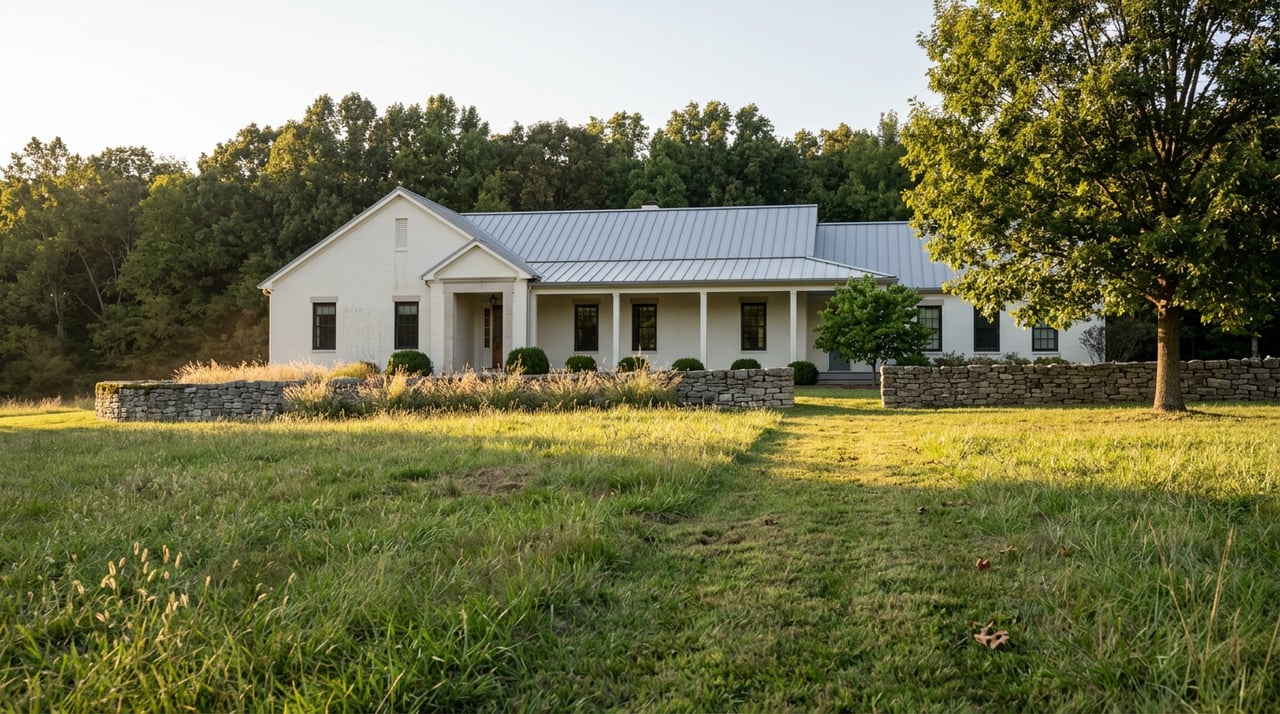
Two ten-acre parcels sit within a few miles of each other in College Grove. Same rolling pasture, same distance to Franklin, same asking price per acre. One listing says "fully approved and recorded septic sites, not preliminary approvals." The other says nothing about septic at all.
That single line is the difference between a buildable homesite and a very expensive piece of scenery. In most of Middle Tennessee, land price tracks acreage, road frontage, and view. In College Grove, and across the rest of Williamson County, the number that actually prices a parcel is the one buried in the disclosures: how many bedrooms the soil will support, and whether anyone has proven it yet.
What the Listing Photo Doesn't Show You
A percolation test measures how fast water moves through soil, which determines whether the ground under a given patch of land can handle a septic drain field. According to TN LDS, Tennessee's rule for when that test is even required comes down to a single threshold: if the soil's absorption rate is slower than 75 minutes per inch, a percolation test has to be performed before anyone can build. Soil that drains faster than that skips the test entirely.
When a test is required, it isn't a single hole dug anywhere convenient. State rule lays the test sites out on a grid with a maximum of 50 feet between points, and each hole is treated as representative of a 2,500 square foot block of ground around it. If that hole fails, the whole block is disqualified for a disposal field. A ten-acre parcel can have plenty of land and still come up short on usable septic ground, because the acreage was never the constraint. The soil was.
There's a second layer buyers routinely miss: Williamson County requires 100 percent reserve area, meaning a property needs twice the usable septic ground that the home actually requires, so there's a place to rebuild the system if the first one ever fails. A parcel that barely clears the bedroom count a buyer wants today may have no room left for that reserve, which matters enormously the day that buyer wants to sell.
This is why the same acreage, priced the same per acre, can carry two completely different real costs to build on. The land is not what's being priced. The soil map is.
Why Williamson County Costs What It Does
Here's the part that surprises people who've built in a neighboring county. A Williamson Herald opinion piece laid out figures from a county-commissioned consultant study and put a number on the gap: the average cost for the septic system Williamson County most commonly requires runs $80,000 to $100,000, split roughly between $30,000 to $40,000 in compliance costs and $50,000 to $60,000 in installation. The same column cited a statewide average closer to $10,000 for a comparable 4-5 bedroom system, pointing to a Maury County homeowner who installed one for $8,760 and a Davidson County homeowner who installed a 5-bedroom system with a barn for $9,500.
Here's how that comparison lines up.
| Typical 4-5 Bedroom System Cost | |
|---|---|
| Statewide Tennessee average (per Williamson Herald column) | roughly $10,000 |
| Maury County example cited | $8,760 |
| Davidson County example cited (with barn) | $9,500 |
| Williamson County average (compliance + installation) | $80,000 to $100,000 |
The same column attributes the gap to county rules that go well beyond the state's own Tennessee Department of Environment and Conservation standards, citing a 2023 study by Thrivence and Barge Design Solutions that found the county requires up to 11 inspections for a single system installation, restricts system types that TDEC otherwise permits, and in one homeowner's account, took close to two years to reach approval. None of this shows up in a listing photo. All of it shows up in a closing statement.
For a buyer comparing College Grove acreage to land just across a county line, that gap is the real story. It's not that College Grove land is overpriced. It's that the cost of turning it into a home is a variable most people never price until they're already under contract.
The Rules Are Being Rewritten While You're Shopping
This isn't a static system a buyer can research once and file away. Williamson County's Board of Health adopted a first round of amendments to the septic regulations on March 17, 2026, touching how the county handles nonconforming systems, floor drain requirements, and setback tables. Then, at a public hearing on June 16, 2026, the Board of Health took up a second and considerably longer list of proposed changes, including how the county defines a bedroom for permitting purposes, how it handles soil modification for secondary disposal areas, and, most relevant to any buyer holding an older soil map, how and when soil maps and percolation tests expire.
That last item matters more than it sounds. A soil map completed under one set of rules may not carry the same weight once the county finishes updating Section 27. A parcel marketed today as "fully approved" was approved under whatever standard existed on the date of that approval, and buyers need to ask when that was, not just whether it happened.
The county's own Subsurface Sewage Disposal System Task Force was formed specifically to study whether Williamson County should keep regulating septic systems more strictly than the state requires, and its final report went to the County Commission in May 2026. Whatever comes out of that process will shape what land costs to build on for years. A buyer signing a contract this fall is buying into rules that are, right now, in the middle of being reset.
Reading a College Grove Land Listing Like Someone Who Knows the Math
Land listings across College Grove and the rest of Williamson County have started marketing septic status the way homes market granite counters, because sellers know it's the thing buyers should be asking about. Phrases like "fully approved 5-bedroom soil map" or "septic system perked for five bedrooms" show up again and again for a reason. Before treating any of those phrases as settled fact, a buyer should ask for four things:
- Whether the soil map or perc test shown is preliminary or final and recorded with the Williamson County Department of Sewage Disposal Management
- The bedroom count the approval actually covers
- Whether the property has the full 100 percent reserve area documented, not just the primary field
- The date of the approval, given that the county is actively revising how long soil maps and perc tests remain valid
None of this shows up in a drone photo of a pasture. These details are worth reviewing before a buyer commits to a price.
What This Means for a Buyer Right Now
The acreage number on a College Grove listing tells a buyer how much ground they're getting. It tells them almost nothing about how much of that ground can actually carry a house, and even less about what it will cost to make it official under a county code that's currently being rewritten section by section. The parcels worth paying a premium for are the ones where someone has already done that work and can produce the paperwork to prove it.
If you're comparing acreage in College Grove against land elsewhere in Williamson County, or trying to figure out whether a "preliminary soil site" is worth what it's being marketed for, that's exactly the kind of due diligence The Phillips Group runs before a client ever writes an offer. Start Your Home Search with a team that reads the soil map before the sign goes up in the yard.
A Couple of Things Buyers Ask
Does a percolation test expire in Williamson County? The county's regulations currently address expiration of soil maps and percolation tests under Section 27, and that section was one of the items on the table at the June 2026 public hearing. A buyer should always confirm the date of the approval on file and ask directly whether it's still considered current under whatever standard applies at the time of purchase, rather than assuming an older approval automatically holds.
What is a septic reserve area, and why should a buyer care? Williamson County requires a property to set aside a second area equal in size to the primary septic field, so there's room to build a replacement system if the original ever fails. A parcel that only has enough approved soil for the field it needs today, with no documented reserve, carries more long-term risk and can be harder to finance a future addition or resale around.
This article is general information, not legal, tax or financial advice. Consult a qualified professional about your situation.