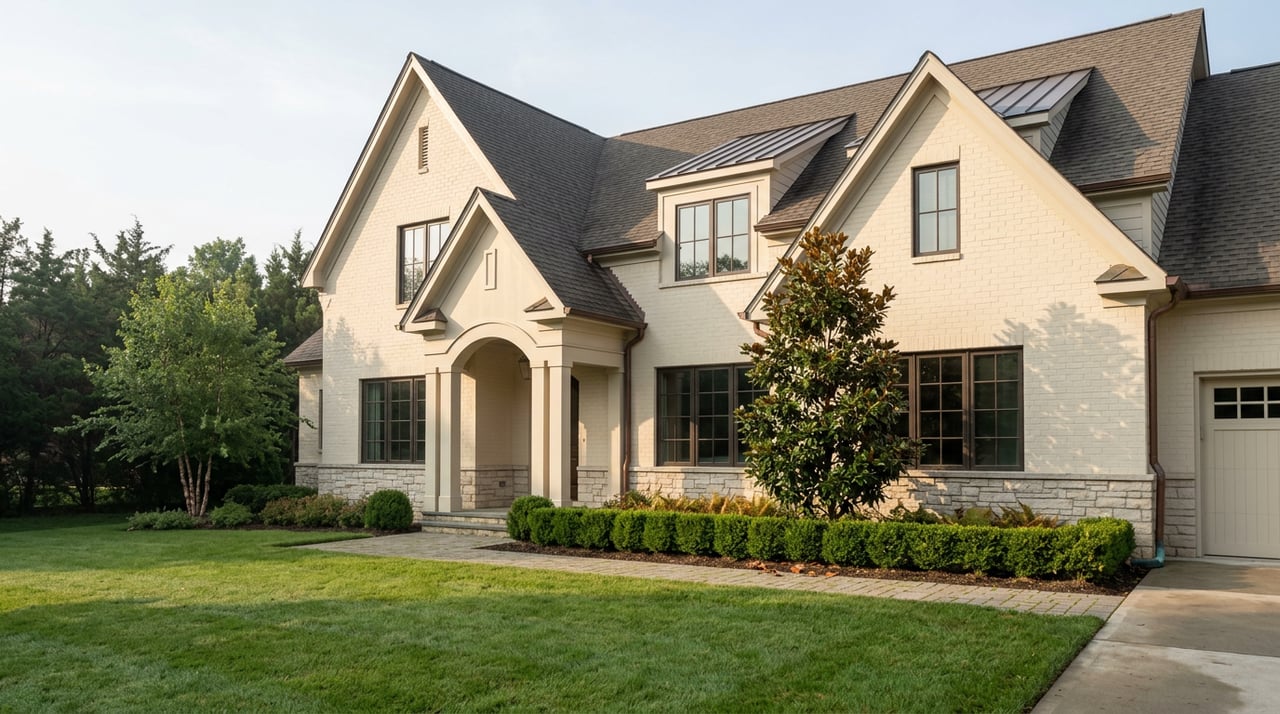
What does $864,000 actually buy in Franklin, Tennessee this fall? The honest answer is that the question itself is broken. Franklin's citywide median sale price sat at $864,000 over the three months ending in June 2026, up 5.3 percent from the same period a year earlier. That number gets repeated in every market update, every listing alert, every conversation that starts with "so what are homes going for out there." It also describes almost nobody's actual house.
The median is a single line drawn through at least four neighborhoods that don't compete with each other in any meaningful sense. A buyer with $900,000 to spend in Westhaven is shopping a different product than a buyer with $900,000 to spend in Fieldstone Farms, even though both are technically inside the same citywide statistic. Understanding why matters more this fall than it did a year ago, because two pieces of new infrastructure landing in Franklin right now are actively redrawing which neighborhoods compete against which, before the price data has caught up to reflect it.
One Median, Several Products
Averaging home prices across Franklin and calling it "the market" is a little like averaging the price of a bicycle and a pickup truck and reporting the result as "the price of a vehicle." Both numbers are real. Neither tells you what you're actually buying.
Franklin's overall pace backs this up in a smaller way too. Homes across the city sold in an average of 48 days over the three months ending in June 2026, with sellers netting about 2 percent below asking price on average. That's a reasonably calm, balanced market on paper. But "balanced" citywide can mean brisk in one subdivision and unhurried in another, and the only way to know which one you're standing in is to look neighborhood by neighborhood rather than trusting the blended number.
What Each Budget Actually Buys
Four Franklin communities illustrate how differently the same dollar amount behaves depending on where it lands.
| Neighborhood | What you're actually buying | Recent price signal |
|---|---|---|
| Westhaven | Village-style walkability, a Town Center anchored by restaurants like Puckett's, Coal Town Public House, and Oscar's Taco Shop, plus a 15,000-square-foot Residents Club with a fitness center and theater | Closings ranged from $705,000 to $5.7 million in April 2026 alone, with a rolling 12-month median near $1.33 million based on RealTracs MLS data |
| Berry Farms | Walkable retail and dining built into the residential layout, now sitting directly next to a new 100,000-square-foot corporate campus | A new-construction three-bedroom listed at $747,850 in mid-July 2026 |
| McKays Mill | Golf-adjacent, established family community with a strong price-to-value ratio | Recent listings clustering near $800,000 |
| Fieldstone Farms | Decades of mature trees and established schools rather than new amenities | Listings averaging around $660,000 |
Westhaven's own price range tells the story better than any single median could. A townhome near the Town Center and a custom estate on a larger lot both closed inside that same neighborhood in the same month, at prices five to six times apart. Buying "in Westhaven" doesn't specify a price point on its own. It specifies a lifestyle, and the lifestyle comes in several sizes.
Two New Additions Are Redrawing the Comparison
If Franklin's submarkets were static, this would just be a useful way to shop. But two things landed in 2026 that are actively changing which neighborhoods sit next to each other on a buyer's shortlist.
The first is right next to Berry Farms. In-N-Out Burger broke ground on a 100,000-square-foot Eastern Territory office adjacent to the neighborhood in September 2024, a project the company says represents a $125.5 million investment and roughly 277 new jobs in Williamson County. The restaurant itself, built along Goose Creek Drive near the corporate office, opened to customers in early 2026. That's a meaningful shift in daily life for anyone living within walking or short-driving distance: a large new employer, a new dining option, and the kind of foot traffic that changes how a neighborhood feels on a Tuesday night. None of that shows up in a comp sheet yet. Price data lags behind lived experience by months, sometimes longer, which means this fall's Berry Farms listings are being priced against a version of the neighborhood that's already out of date.
The second is a new top-of-market entrant. Toll Brothers opened its Franklin Ridge community for sales near the McEwen interstate interchange, offering 34 single-family homesites priced from $1.5 million, with several lots offering second-level balconies facing Ropers Knob. Before Franklin Ridge, a buyer at that budget in Franklin was largely choosing between an established Westhaven estate lot or custom acreage outside the subdivisions. Now there's a genuinely new product sitting at the same price floor, built new rather than resold, with the personalization options that come standard at Toll Brothers' design studio. That doesn't make Westhaven less desirable. It does mean the comparison a $1.5 million buyer runs this fall includes an option that didn't exist a year ago.
Why This Changes How You Compare Neighborhoods
The practical takeaway isn't that Franklin's median is wrong. It's that the median was never built to answer the question most buyers are actually asking, which is "what does my specific budget get me, in a neighborhood that fits how I want to live."
A buyer comparing Westhaven and Berry Farms at $900,000 is choosing between an established village with a deep amenity package and a newer, more compact community that just gained a major employer next door. A buyer at $1.5 million is now choosing between a mature Westhaven estate and brand-new construction at Franklin Ridge, two products that didn't sit on the same shortlist eighteen months ago. A buyer at $700,000 is likely comparing Fieldstone Farms and McKays Mill against each other, where the real difference comes down to how much of that price is buying established landscaping versus a slightly better floor plan.
None of these three buyers are shopping the same market, even though a citywide report will happily fold all three into one median and one days-on-market figure. Reading Franklin's market well in the fall of 2026 means asking which of these products your budget actually lands you in, not what the city-wide number says.
A Few Questions Worth Asking Before You Compare
Does a lower price per square foot in Franklin always mean a better deal? Not on its own. A lower price per square foot in Fieldstone Farms is often buying mature trees and decades of established landscaping rather than fewer amenities than Westhaven. The comparison only makes sense once you've decided what you want the house to do for your daily life.
Is Franklin Ridge really comparable to Westhaven? Only if your budget clears $1.5 million. Below that, Franklin Ridge isn't in the conversation, since its 34 homesites start at that price floor. Above it, the comparison becomes real: new construction with design-studio personalization at Franklin Ridge versus an established, resale-heavy village at Westhaven.
Will the In-N-Out opening change Berry Farms values right away? Not immediately, and that's the point. The restaurant and corporate office are already open, but sale comps take months to reflect a neighborhood change like this. Listings priced this fall are largely being priced against last year's version of Berry Farms, which is worth knowing whether you're the buyer or the seller.
Franklin's market rewards buyers who stop asking what the median is and start asking which product their number actually buys. That's a harder question to answer from a portal alert, and it's exactly the kind of neighborhood-by-neighborhood read The Phillips Group works through with clients before they ever write an offer. If you're trying to figure out which Franklin submarket your budget actually belongs in, Start Your Home Search with a team that tracks these shifts as they happen, not after they show up in next quarter's median.